
 English
  Italian
  Spanish
  Thai
Thai  Japanese
  Portuguese
  Korean
  Russian
  French
  German
  Polish
  Arabic
  Indonesian
The role of a bulk pharmaceutical intermediates supplier extends far beyond producing and shipping chemical materials. In a GMP-oriented pharmaceutical supply chain, the supplier's manufacturing controls can directly influence downstream synthesis, impurity management, batch release, regulatory documentation, and production continuity.
This becomes particularly important when intermediates are purchased in commercial quantities and incorporated into multi-step API manufacturing. The supplier must be able to maintain consistent chemistry across batches while providing sufficient documentation to support quality assessment and traceability.
For global pharmaceutical companies, the most reliable sourcing model combines scalable manufacturing technology, analytical control, GMP-oriented operations, and stable international logistics.
What Makes an Intermediate Supplier GMP-Ready?
GMP-oriented supply is based on controlled processes rather than a final inspection alone.
The manufacturing process should define critical parameters such as reaction temperature, pressure, addition rate, reaction time, mixing conditions, purification parameters, and drying conditions where applicable.
The supplier must also control changes to the established process.
If a raw material, catalyst, production vessel, purification method, or analytical procedure changes, the potential effect on the intermediate should be assessed through an appropriate change-control process.
This is particularly important for pharmaceutical intermediates because apparently minor process changes can alter impurity profiles.
Raw Material Control Is the First Quality Barrier
The final quality of an intermediate depends partly on the quality of the materials entering the process.
Raw-material specifications should therefore be defined according to their role in the synthesis.
For critical starting materials, important attributes may include assay, impurity profile, water content, residual solvents, and physical characteristics.
Supplier qualification and incoming inspection help prevent uncontrolled variation from entering the manufacturing process.
Once raw materials are controlled, the production process can operate within a more predictable chemical environment.
Reaction Control Determines Impurity Formation
Many impurities originate during the reaction stage.
An excessive temperature, extended reaction time, incorrect reagent ratio, insufficient mixing, or incomplete conversion can increase the formation of by-products.
For high-temperature and high-pressure reactions, these variables become particularly important because reaction rates may change significantly with operating conditions.
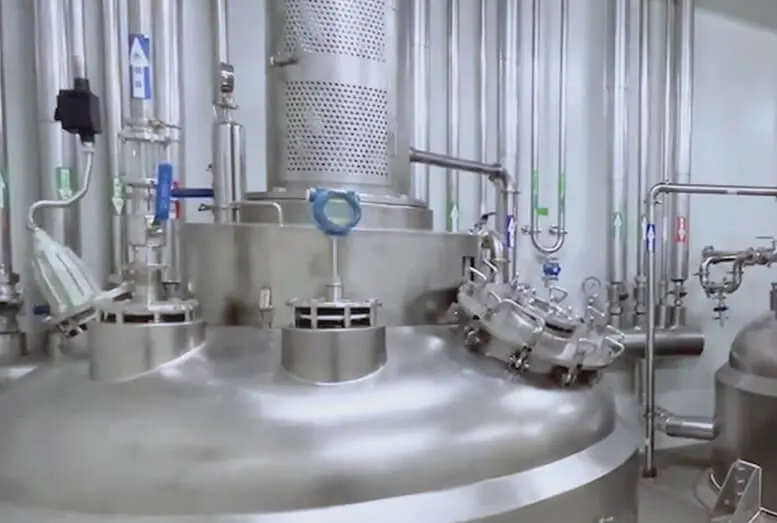
Jiangsu Jingye Pharmaceutical has specialized capabilities in high-temperature and high-pressure reactions, supporting processes where controlled thermal and pressure conditions are required.
The objective is to establish a reproducible process window rather than relying on operator experience alone.
Purification Determines Final Intermediate Quality
Even when the reaction itself performs well, the resulting mixture may contain unreacted starting materials, reaction by-products, catalysts, solvents, or structurally related compounds.
Purification must therefore be designed around the impurity profile.
Possible technologies include crystallization, filtration, extraction, conventional distillation, high-vacuum distillation, or combinations of multiple separation steps.
High-vacuum distillation is particularly useful for selected compounds where reduced pressure can lower boiling temperature and reduce thermal exposure.
The appropriate purification route depends on the physical and chemical properties of both the target intermediate and the impurities.
Drying Can Affect Downstream Performance
Drying is sometimes treated as a simple final operation, but residual moisture can be a critical quality attribute.
A material intended for moisture-sensitive downstream synthesis may require tighter water control than an intermediate used in a less sensitive process.
Drying temperature, pressure, duration, equipment configuration, and product loading can all influence the final moisture level.
Karl Fischer testing can provide quantitative verification when water content is part of the product specification.
The supplier should therefore establish drying conditions that are reproducible across commercial batches.
Analytical Release Should Match the Risk Profile
A certificate of analysis is useful only when its test methods address the parameters that matter for the intended application.
Typical analytical attributes may include assay, related substances, residual solvents, water, appearance, melting point, and other product-specific characteristics.
For more complex intermediates, additional structural or stereochemical analysis may be required.
Jiangsu Jingye Pharmaceutical maintains advanced analytical instruments and a professional technical team to support quality assessment and production control.
The analytical program should be connected to the manufacturing process so that significant process deviations can be investigated using appropriate analytical evidence.
Documentation Supports Global Pharmaceutical Qualification
International pharmaceutical customers frequently require more than product samples.
Supplier qualification may involve manufacturing information, specifications, analytical methods or method information, batch records or summaries, certificates, quality agreements, change-control procedures, and other documentation depending on the customer's requirements.
A supplier that can provide consistent and traceable documentation reduces the administrative burden associated with technical qualification.
For global customers, documentation consistency is particularly important because quality information may need to be reviewed by multiple technical and regulatory teams.
EHS Is Part of Manufacturing Reliability
Pharmaceutical intermediate production can involve flammable solvents, reactive chemicals, toxic substances, corrosive materials, and pressurized gases.
A mature EHS system should therefore cover process safety, chemical storage, waste management, worker protection, emergency response, and environmental controls.
Jiangsu Jingye Pharmaceutical maintains a complete EHS system and holds ISO 14001 and GB/T 45001 certifications alongside ISO 9001.
These systems support a broader approach to operational risk management.
A stable EHS framework also contributes to supply continuity because serious safety or environmental incidents can cause prolonged production interruptions.
R&D Capability Supports Process Optimization
Commercial production requirements can change as customer demand grows or downstream processes are optimized.
A supplier with internal R&D capabilities can investigate process improvements, impurity reduction, yield optimization, and scale-up challenges without separating development from manufacturing.
Jiangsu Jingye Pharmaceutical maintains long-term cooperation with universities and research institutions, providing additional technical resources for pharmaceutical R&D.
This type of technical ecosystem can be valuable when an intermediate requires customized process development rather than simple catalog purchasing.
International Manufacturing Requires Supply Continuity
A global pharmaceutical customer may need predictable delivery across multiple production cycles.
Supply continuity depends on manufacturing capacity, raw-material availability, equipment reliability, quality release timing, packaging, export documentation, and logistics.
Jiangsu Jingye Pharmaceutical operates from a 50,000-square-meter site in Changzhou and exports products to Europe, America, Southeast Asia, Japan, and South Korea.
For long-term sourcing, production capacity should be evaluated against forecast demand rather than a single purchase order.
A supplier capable of supporting both regular commercial production and reasonable demand fluctuations provides greater flexibility for downstream manufacturing planning.
Building a More Reliable Supplier Evaluation Model
The most useful supplier assessment combines technical and operational factors.
Manufacturing technology determines whether the supplier can produce the required chemistry. Quality systems determine whether the process remains controlled. Analytical capabilities determine whether critical attributes can be measured. EHS systems influence operational continuity. Production capacity and international logistics determine whether the material can be delivered consistently.
This integrated assessment is more informative than comparing unit prices alone.
For pharmaceutical intermediates, the lowest purchase price can become expensive if inconsistent quality creates additional testing, process adjustments, rejected batches, or downstream production delays.
Conclusion
A reliable bulk pharmaceutical intermediates supplier should provide controlled chemistry, consistent analytical results, GMP-oriented manufacturing, complete traceability, strong EHS management, scalable production, and dependable international supply.
Jiangsu Jingye Pharmaceutical combines pharmaceutical R&D, commercial manufacturing, analytical capabilities, international trade, and process technologies including hydrogenation, high-temperature and high-pressure reactions, chiral synthesis, and high-vacuum distillation.
For pharmaceutical manufacturers building long-term supply chains, evaluating these capabilities together provides a more technically sound basis for supplier selection and helps reduce the risks associated with batch variation, scale-up, regulatory qualification, and production continuity.