
 English
  Italian
  Spanish
  Thai
Thai  Japanese
  Portuguese
  Korean
  Russian
  French
  German
  Polish
  Arabic
  Indonesian
Scaling pharmaceutical intermediate production from laboratory synthesis to industrial batches creates a fundamental engineering challenge: the chemistry may remain unchanged, but the physical conditions surrounding the chemistry do not.
Mixing, heat transfer, gas-liquid contact, reaction kinetics, vacuum performance, crystallization, and impurity behavior can all change when reactor volume increases. This is why selecting a large scale reactor pharmaceutical intermediates manufacturer China should focus on scale-up engineering capability rather than production capacity alone.
For companies developing APIs or advanced intermediates, a reliable manufacturing partner must be able to maintain critical process parameters as batch size increases while controlling quality, safety, and production efficiency.
Why Laboratory Results Cannot Simply Be Enlarged
A laboratory reactor may have a high surface-area-to-volume ratio, allowing heat to be transferred efficiently. When the same reaction is transferred into a much larger vessel, the amount of reaction mass increases faster than the available heat-transfer surface.
This creates a potential difference between laboratory and commercial operation. An exothermic reaction can experience slower heat removal, while a cooling step may require significantly more time. Mixing can also become less uniform if agitation is not appropriately scaled.
The scale-up process therefore needs to evaluate temperature profiles, agitation, feed rates, heat-transfer coefficients, reaction time, and quenching conditions instead of simply multiplying laboratory quantities.
Reactor Configuration Influences Process Stability
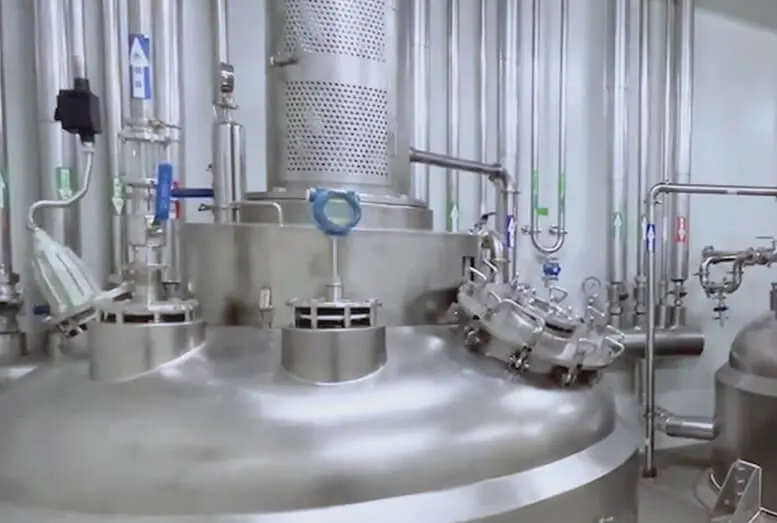
For pharmaceutical intermediates, reactor selection should reflect the chemistry being performed. Reaction temperature, pressure, solvent system, corrosion characteristics, viscosity, solids content, and gas-liquid interaction all influence equipment requirements.
A reactor used for a low-viscosity liquid reaction has different mixing requirements from one handling a concentrated slurry. Similarly, a hydrogenation process requires effective gas-liquid mass transfer, while a high-temperature reaction may require stronger thermal management.
The engineering objective is to create sufficiently uniform conditions throughout the reaction mass. Temperature and concentration gradients can lead to inconsistent conversion or increased by-products, particularly during sensitive reaction stages.
High-Pressure Hydrogenation at Industrial Scale
Hydrogenation is frequently used to modify pharmaceutical intermediates, but commercial hydrogenation requires coordinated control of hydrogen pressure, temperature, catalyst concentration, agitation, and reaction time.
The hydrogen transfer rate is strongly influenced by gas-liquid mass transfer. If hydrogen availability at the liquid-catalyst interface is insufficient, the reaction may become mass-transfer limited rather than chemically limited.
At the same time, excessive temperature or uncontrolled hydrogen pressure can create unnecessary safety and quality risks. A competent manufacturer must therefore integrate pressure-rated equipment, instrumentation, agitation, cooling, catalyst handling, and process controls into the hydrogenation system.
Jiangsu Jingye Pharmaceutical has specific experience in hydrogenation processes as part of its broader pharmaceutical intermediate manufacturing capabilities.
Chiral Synthesis Requires Process Discipline
Chiral synthesis presents another scale-up challenge because the desired stereochemical outcome can depend strongly on catalyst, reagent ratio, temperature, reaction time, solvent conditions, and mixing.
Small variations that have limited impact on conventional reactions can become significant when the target specification includes strict chiral purity requirements. Consistent raw material quality and accurate dosing are therefore essential.
Analytical verification is equally important. Chiral chromatography and other analytical methods can be used to confirm whether the industrial process maintains the required stereochemical profile.
For a large scale reactor pharmaceutical intermediates manufacturer China, the ability to combine chemical process expertise with analytical verification is a major indicator of scale-up maturity.
High-Vacuum Distillation Can Protect Product Quality
Many pharmaceutical intermediates contain components that are sensitive to prolonged exposure to high temperature. High-vacuum distillation can lower effective boiling temperatures, helping reduce thermal stress during purification.
However, vacuum distillation at industrial scale requires careful coordination between heating, vacuum generation, condensation, and feed control. A weak point in any part of the system can affect the entire separation process.
For high-value intermediates, purification efficiency directly influences yield and production cost. Excessive solvent consumption, extended distillation time, or repeated purification can increase both manufacturing cost and thermal exposure.
Analytical Capability Supports Commercial Consistency
Industrial production cannot rely solely on end-of-batch inspection. Analytical data should support process monitoring and quality decisions throughout production.
Depending on the intermediate, relevant controls may include assay, related substances, residual solvents, water content, purity, and chiral purity. Analytical instruments must be appropriate for the required detection limits and validated methods.
Jiangsu Jingye Pharmaceutical maintains advanced analytical instruments as part of its integrated pharmaceutical manufacturing system. This supports the connection between chemical processing and quality evaluation instead of treating laboratory testing as an isolated final step.
GMP, EHS, and Traceability
A large-scale chemical process must also be reproducible from a documentation and compliance perspective. Batch records, raw material traceability, equipment cleaning, process deviations, analytical results, and change control all contribute to manufacturing consistency.
Safety requirements become increasingly important as production scale increases. Large quantities of solvents, reactive chemicals, hydrogen, and pressurized systems can significantly increase the consequences of process deviations.
Jiangsu Jingye Pharmaceutical operates in accordance with GMP standards and maintains an EHS management system. Its certifications include ISO9001, ISO14001, and GB/T 45001, supporting quality management, environmental management, and occupational health and safety.
A Better Way to Evaluate Manufacturing Capability
When comparing manufacturers, reactor volume should be treated as one parameter within a larger technical evaluation. More meaningful questions include whether the supplier has experience with similar reaction chemistry, whether commercial-scale temperature and pressure conditions can be controlled consistently, and whether analytical methods can verify critical quality attributes.
It is also important to understand how the manufacturer handles process development and scale-up. A supplier capable of supporting technical optimization can often reduce the gap between laboratory chemistry and commercial production.
Jiangsu Jingye Pharmaceutical has operated in pharmaceutical R&D and manufacturing since 1994 and maintains long-term cooperation with universities and research institutions. Its capabilities cover high-temperature and high-pressure reactions, hydrogenation, chiral synthesis, and high-vacuum distillation, providing a broad technical base for complex intermediate production.
Conclusion
Selecting a large scale reactor pharmaceutical intermediates manufacturer China is fundamentally a scale-up decision. Reactor capacity matters, but the ability to control heat, mass transfer, pressure, mixing, purification, analytical quality, and EHS performance matters more.
A technically capable manufacturer should demonstrate that laboratory chemistry can be transformed into a controlled industrial process with reproducible quality and predictable production performance. With integrated R&D, manufacturing, analytical, GMP, and EHS capabilities, Jiangsu Jingye Pharmaceutical provides a technical foundation for pharmaceutical intermediate projects that require reliable transition from development to commercial-scale production.